Does a Gun Safe Need a Dehumidifier?
Yes, you need a dehumidifier in your gun safe to protect your firearms and valuables from moisture damage. Humidity above 50% speeds up rust and corrosion, while low humidity can crack wooden stocks. Using a dehumidifier helps maintain an ideal 30–50% humidity range, preventing mold and warping.
Your choice between desiccant or electric models depends on your climate and safe location. Understanding these factors guarantees your collection stays in peak condition. And there’s more to take into account for effective humidity control.
What Humidity Level Is Best for a Gun Safe?
What humidity level should you maintain inside your gun safe to protect your firearms effectively? The ideal humidity level ranges between 30% and 50%. This range minimizes moisture buildup, preventing rust and corrosion on your firearms.
Maintain gun safe humidity between 30% and 50% to prevent rust and corrosion on firearms.
If humidity drops below 20%, wooden gun stocks risk shrinking and cracking. On the other hand, excessive moisture promotes damage not only to guns but also to other valuables stored inside. So, it’s really about finding that sweet spot.
To maintain this balance, using a dehumidifier tailored for gun safes is essential. It actively controls moisture, ensuring the environment stays within the best range.
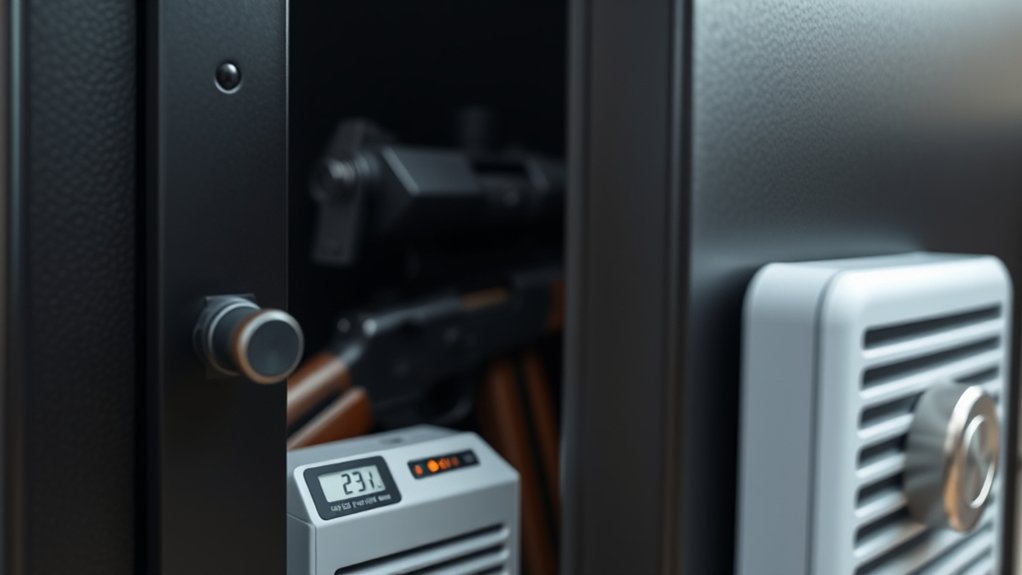
Plus, regularly monitoring humidity with a hygrometer gives you real-time data. This way, you can easily adjust your dehumidifier or ventilation as needed.
Keeping the temperature around 70°F along with proper humidity further stabilizes conditions, helping to safeguard your collection effectively.
How Does Humidity Damage Firearms and Gun Safe Valuables?
When humidity rises above the ideal range, it speeds up rust and corrosion on your firearms. This directly affects how well they work and how they look. Moisture builds up and causes oxidation on metal parts.
At the same time, wooden parts can warp or crack, which weakens their structure.
Too much humidity also encourages mold and mildew to grow. This can harm your firearms and other valuables. If humidity goes over 50%, you’re more likely to see permanent damage to sensitive items like papers and electronics stored in your gun safe.
Keeping humidity steady between 30% and 50% is key to avoiding these problems. It helps protect your collection and keeps it in good shape for longer.
Without controlling moisture, you could face expensive damage. Using a dehumidifier is a smart way to manage humidity. It cuts down moisture and keeps your firearms and valuables safe from rust and other moisture-related damage.
What Is a Gun Safe Dehumidifier and How Does It Work?
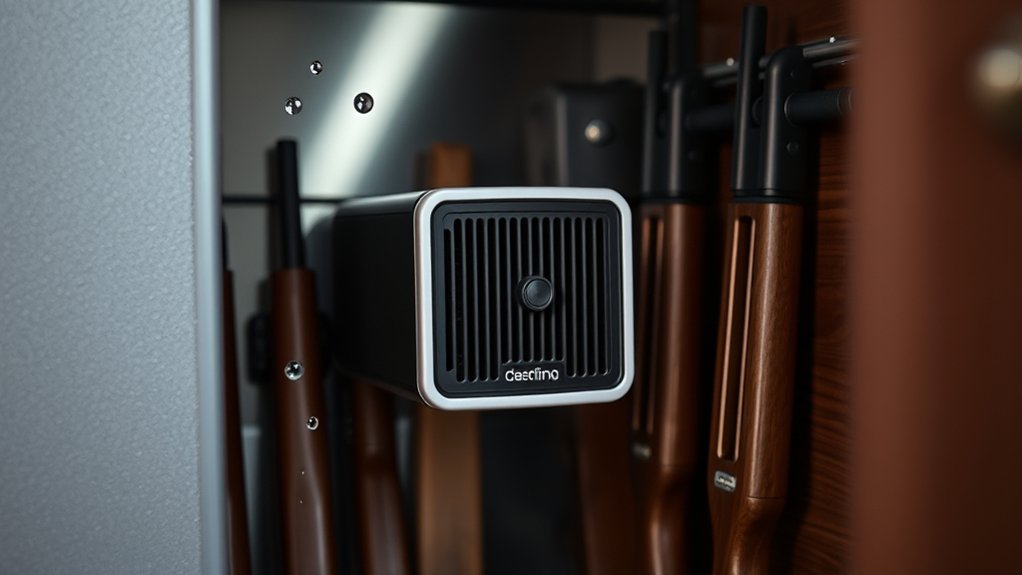
Because maintaining proper humidity inside your gun safe is essential, using a dehumidifier becomes an effective solution to control moisture levels. A gun safe dehumidifier removes excess moisture from the air, preventing rust and corrosion on firearms and valuables.
Maintaining proper humidity with a dehumidifier protects your firearms from rust and corrosion.
It works primarily through two methods: chemical absorption using a desiccant, such as silica gel, or electric systems that heat and circulate dry air. The desiccant attracts and holds moisture, requiring periodic replacement, while electric models actively regulate humidity levels via continuous operation.
Proper placement of the dehumidifier inside the safe optimizes moisture absorption and maintains a consistent dry environment.
Monitoring with a hygrometer guarantees the dehumidifier effectively keeps humidity levels between 30% and 50%, which is the ideal range for preserving your firearms and valuables.
What Types of Dehumidifiers Are Available for Gun Safes?
Although several dehumidifier options exist, choosing the right type for your gun safe depends on factors like size, maintenance, and power availability.
Desiccant dehumidifiers use moisture-absorbing materials such as silica gel or calcium chloride. They’re budget-friendly but require periodic replacement to stay effective.
Electric dehumidifiers, on the other hand, plug in and employ heating elements with air circulation, offering more thorough humidity control.
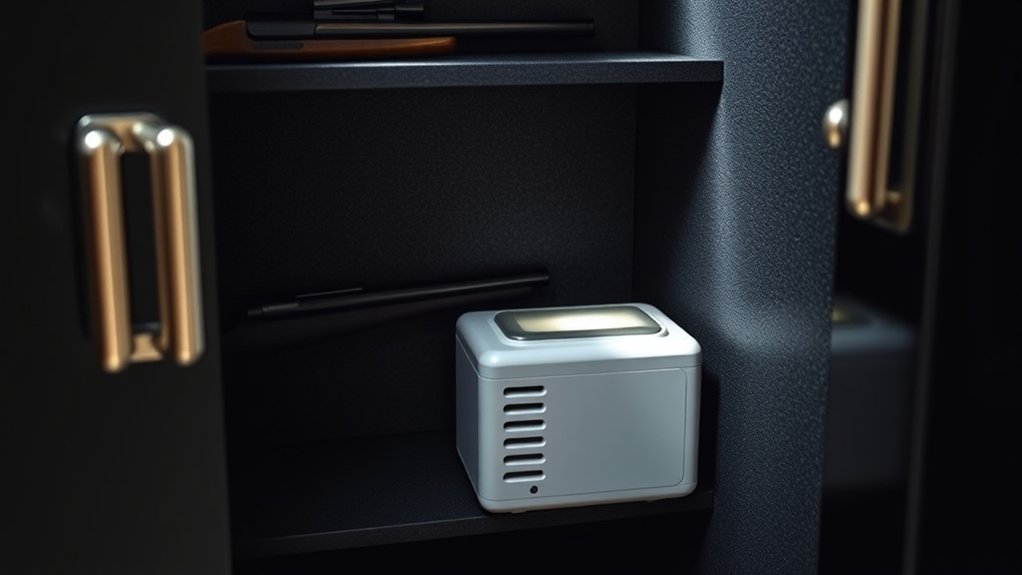
Mini dehumidifiers are compact devices designed specifically for gun safes. They combine moisture absorption with heating rods to enhance protection.
Canister dehumidifiers rely on chemical crystals to absorb moisture but need regular monitoring and replacement.
While refrigerant-based units are highly effective, they’re generally impractical for gun safes due to size and power demands.
Understanding these options lets you select the best dehumidifiers for gun storage needs.
When Should You Choose a Desiccant or Electric Dehumidifier?
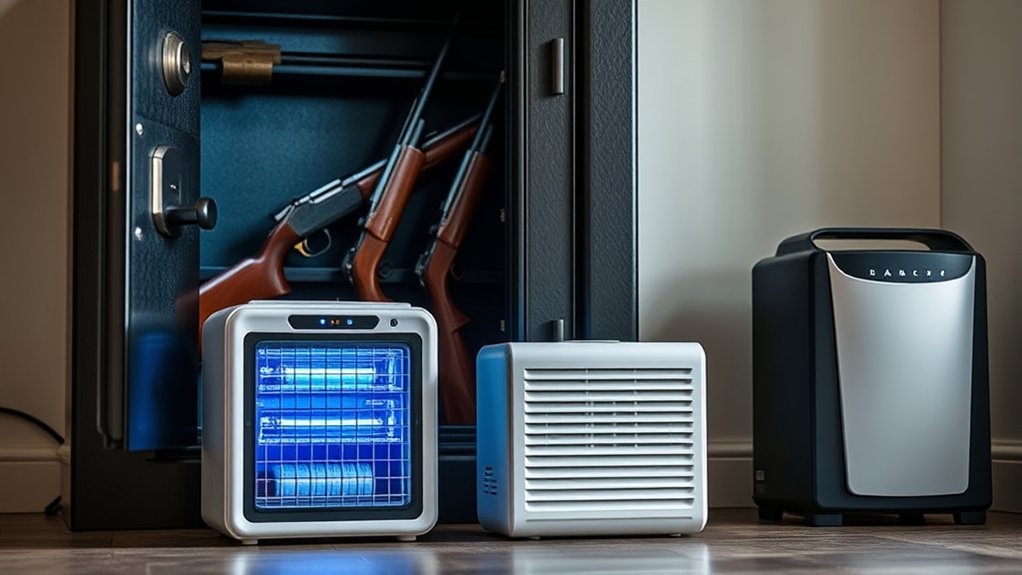
When deciding between a desiccant and an electric dehumidifier, it really helps to think about your local climate, whether you have easy access to power, and how much upkeep you’re comfortable with.
Desiccant dehumidifiers work best in drier areas, but keep in mind they need regular replacement.
On the other hand, electric models are great for more humid conditions and usually require less maintenance, though they do need a constant power source.
Climate Considerations
When humidity levels regularly surpass 50%, opting for an electric dehumidifier guarantees effective moisture control to protect your firearms from rust and corrosion.
In humid climates, electric dehumidifiers continuously extract humidity from the air, maintaining ideal conditions inside your gun safe.
Conversely, desiccant dehumidifiers are better suited for low-humidity environments or smaller safes, as they absorb moisture without electricity but require frequent replacement.
You should monitor humidity closely with a hygrometer to keep levels between 30% and 50%, ensuring consistent protection.
If your climate experiences fluctuating humidity or your safe is in a damp location like a basement or garage, combining both electric and desiccant dehumidifiers provides thorough control.
This approach effectively mitigates moisture risks and preserves your firearms’ integrity.
Power Availability
Two main types of dehumidifiers serve gun safes based on power availability: electric models and desiccant varieties.
Electric dehumidifiers rely on consistent power to use heating elements and air circulation, efficiently controlling humidity levels.
Desiccant dehumidifiers, however, operate without electricity, using moisture-absorbing materials like silica gel.
When choosing between them, consider these factors: availability of electrical outlets near the safe.
Local humidity levels—higher humidity favors electric models.
Your preference for monitoring saturation indicators in rechargeable desiccants.
And your willingness to replace or recharge desiccant materials regularly.
If power is accessible and you want continuous air circulation, electric dehumidifiers offer superior performance.
For remote or power-limited areas, desiccant options maintain dryness effectively without electricity.
Maintenance Requirements
Although both desiccant and electric dehumidifiers serve to protect your gun safe from moisture damage, their maintenance demands differ considerably and should guide your choice.
Desiccant dehumidifiers require no electricity but need periodic replacement of moisture-absorbing materials. This makes them ideal for low-humidity environments where maintenance is straightforward but ongoing.
Electric dehumidifiers demand regular monitoring to guarantee heating elements and air circulation function properly. However, they offer superior moisture control, especially in humid spaces prone to rust and corrosion.
Using a hygrometer, you can track humidity levels and decide when replacements or servicing are necessary.
If your gun safe is in a moisture-prone area like a basement or garage, an electric dehumidifier’s maintenance, though more involved, provides more reliable protection against rust and moisture damage over time.
It’s a bit more work, but the extra care pays off in the long run.
How to Monitor and Maintain Humidity Inside Your Gun Safe
How can you guarantee the humidity inside your gun safe stays within the ideal 30% to 50% range? Start by using a reliable hygrometer to continuously monitor moisture levels.
Then, implement a maintenance routine focused on these key steps:
- Regularly check and replace desiccant packs like silica gel to maintain moisture absorption.
- Schedule routine inspections for electric dehumidifiers, confirming they operate efficiently and water reservoirs are drained.
- Keep your gun safe in a stable environment with consistent temperature and ventilation to minimize external moisture intrusion.
- Combine multiple humidity control methods, especially in humid climates, for enhanced protection against corrosion.
Taking these steps will help keep your gun safe rust-free and your firearms in peak condition.
Following these steps ensures your gun safe stays rust-free and your firearms remain in top shape.
It’s all about staying proactive and on top of humidity control. That way, you can relax knowing your collection is well protected.
How Location Affects the Need for a Gun Safe Dehumidifier
Where you put your gun safe really plays a big role in how much moisture builds up inside. For example, if it’s tucked away in a basement, garage, or close to water sources like bathrooms, you’re more likely to see higher humidity levels.
Now, if you live somewhere that’s naturally humid or experiences seasonal spikes in moisture, having a dehumidifier becomes even more important. It helps keep your firearms safe from rust and damage.
Moisture-Prone Areas
Because gun safes in basements, garages, or humid regions often experience moisture levels above the ideal 30%-50% range, you need to contemplate a dehumidifier to protect your firearms.
Excess moisture accelerates rust and corrosion, compromising your gun safe’s contents. Even with central air conditioning, these areas remain vulnerable.
Think about this: basements and garages typically have higher humidity than living spaces.
And humid climates, like in the southeastern U.S., really increase moisture risks.
Well-ventilated locations help reduce moisture buildup, but they don’t eliminate it completely.
That’s why dehumidifiers are so useful—they actively maintain optimal conditions and prevent rust or corrosion.
Climate Impact Considerations
Although your gun safe’s location plays a vital role in moisture exposure, understanding the specific climate factors affecting that area helps you determine the necessity of a dehumidifier.
In humid regions like the southeastern U.S., high humidity promotes moisture buildup inside your gun safe, making a dehumidifier indispensable to prevent rust and corrosion. Even with central air conditioning, humidity above 50% demands additional moisture control.
Basements and garages, often more humid than living spaces, increase this risk further. In climates with seasonal humidity swings, a dehumidifier maintains stable conditions within the ideal 30% to 50% range.
Conversely, in dry climates, you mightn’t need a dehumidifier, but monitoring humidity is vital since levels below 20% can harm wooden gun stocks.
Tailoring moisture management to your climate guarantees peak firearm preservation.
How to Lower Humidity Effectively in Your Gun Safe
Anyone aiming to protect firearms from rust and corrosion needs to control the humidity inside their gun safe carefully.
To lower humidity effectively, you want to keep levels between 30% and 50%, ideally near 70°F.
You might need a dehumidifier to absorb moisture and maintain these conditions.
Here’s how to do it efficiently:
- Use a desiccant dehumidifier like silica gel or calcium chloride to absorb moisture, especially in low-humidity settings.
- Consider electric dehumidifiers for active moisture control, circulating warm, dry air.
- Seal your safe using plastic or metal containers to minimize moisture exposure.
- Regularly monitor humidity levels with a hygrometer and replace or recharge desiccants as needed.
Doing these things will help keep your firearms rust-free and well-preserved.
It’s really all about consistent care and attention.
How to Choose the Best Dehumidifier for Your Gun Safe
Maintaining the right humidity level is key to preserving your firearms, but selecting the right dehumidifier can make all the difference in how effectively you manage moisture inside your gun safe.
Start by evaluating your local humidity levels, aiming to keep them between 30% and 50%.
Choose from types of dehumidifiers based on your needs. Electric models offer consistent control, while desiccant options are cost-effective and electricity-free.
For standard gun safes, mini dehumidifiers fit compact spaces without sacrificing performance.
Use a hygrometer to monitor humidity levels continuously. This way, you can make sure your gun safe remains moisture-free.
Finally, maintain your device properly. Replace desiccants or drain reservoirs regularly to guarantee peak performance and protect your firearms from corrosion and damage.
Troubleshooting Common Gun Safe Humidity Problems
Why does your gun safe still show signs of moisture despite using a dehumidifier? Excess moisture can persist due to overlooked factors.
First, monitor humidity levels with a hygrometer; aim for 30%-50%.
Next, check if your safe is located in a high-humidity area like a basement. If you use desiccant beads, refresh or replace them regularly to maintain absorption.
Also, make sure the safe’s seal is tight to block external moisture from getting in.
If problems continue, consider upgrading to an electric dehumidifier for consistent control, especially where humidity exceeds 50%.
Frequently Asked Questions
Can a Dehumidifier Prevent Mold Inside My Gun Safe?
Yes, a dehumidifier can prevent mold inside your gun safe by providing effective humidity control. By maintaining ideal moisture levels, it helps keep mold at bay and supports the overall maintenance of your safe.
You’ll be managing the climate inside, which reduces the dampness that causes mold growth on wood and metal parts.
Using a dehumidifier along with regular humidity monitoring is a smart move. This combo ensures precise climate management inside the safe.
Over time, it protects your firearms and valuables from damage caused by mold.
Are Dehumidifiers Noisy When Used in Gun Safes?
Dehumidifier noise varies depending on the dehumidifier types you choose for your gun safe. Electric models produce 30-50 decibels, similar to a quiet fridge, while desiccant types operate silently.
Maintaining safe humidity and moisture control requires good air circulation, which some noisier units provide better.
Mini dehumidifiers offer quieter operation but might sacrifice capacity. You’ll want to balance noise levels and effectiveness by checking sound ratings before selecting the ideal unit for your safe.
How Often Should I Replace Dehumidifier Packets in My Gun Safe?
Imagine opening your gun safe to find everything perfectly dry and organized. That’s the result of diligent dehumidifier maintenance.
You should replace dehumidifier packets every 2 to 4 months to maintain ideal humidity control and guarantee moisture prevention.
In especially humid environments, check them monthly. Watch for color changes or dampness as clear signs.
Staying on top of this protects your safe’s contents and preserves your organization efficiently.
Can I Use Household Dehumidifiers Inside a Gun Safe?
You shouldn’t use household dehumidifiers inside a gun safe because they’re too large and disrupt moisture levels with excessive heat and airflow.
Instead, focus on specialized dehumidifier types designed for safe placement, like mini or desiccant models. These offer precise humidity control and maintain ideal moisture levels without damaging firearms.
Always monitor with a hygrometer to confirm your safe’s environment stays stable and suitable for preservation.
It’s a simple step that makes a big difference in keeping your guns in top shape.
Do Dehumidifiers Affect the Warranty of My Gun Safe?
Think of your gun safe warranty like a delicate contract. Using dehumidifiers usually won’t break it. Most manufacturers allow chemical and electric dehumidifier types without voiding warranty limitations, as long as you respect safe materials and install properly.
Managing humidity levels protects your valuables and aligns with warranty terms.
Still, always review your specific warranty details. Ignoring manufacturer guidelines could risk coverage and undermine your safe’s protection.
Conclusion
To protect your prized firearms, prioritize proper protection by pairing your gun safe with a powerful dehumidifier. Maintaining manageable moisture minimizes mold, metal malfunctions, and musty messes.
Whether you choose a desiccant or electric option, understanding your environment guarantees effective humidity handling. Don’t delay—dedicate yourself to diligent dryness. Doing so delivers dependable defense, prolonging your prized possessions’ performance and preserving their precision for years to come.