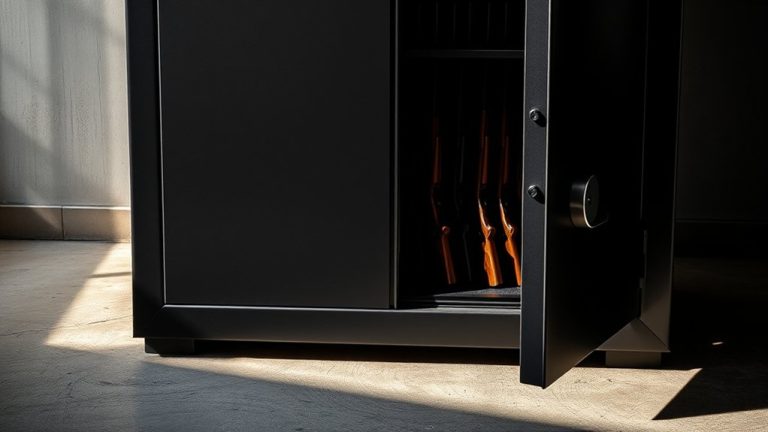
What Makes a Gun Safe Fire Resistant?
You rely on thick steel construction combined with multi-layered fireboard insulation to keep your gun safe’s interior below 350°F during intense fires reaching 1,200°F. Fire-retardant seals like Palusol™ prevent smoke and gases from entering, while advanced materials such as ceramic wool enhance thermal resistance without harmful emissions.
Precise door fit and durable locking mechanisms maintain safe integrity. Understanding these elements helps you evaluate fire ratings, testing, and the impact on cost and protection effectiveness. It’s really about knowing what makes your safe truly fire resistant.
What Fire Resistance Means for Protecting Your Guns
When protecting your guns from fire damage, understanding fire resistance ratings is crucial because they indicate how long a safe can maintain internal temperatures below 350°F despite external heat reaching around 1,200°F.
A fireproof gun safe uses specialized materials like gypsum board and composite insulation that release moisture when heated, effectively slowing temperature rise inside.
The fire rating, typically spanning 30 to 120 minutes, quantifies this resistance. You should prioritize safes with higher fire ratings to protect sensitive contents, as paper ignites at 451°F and plastics melt at lower temperatures.
Furthermore, features like Palusol™ door seals and thicker steel enhance fire resistance by preventing heat and smoke ingress.
This precise engineering guarantees your firearms remain secure and undamaged during intense fire exposure.
Understanding Fire Ratings for Gun Safes
Fire ratings for gun safes specify how long the safe can maintain internal temperatures below critical thresholds, typically 350°F, while exposed to external heat up to 1,200°F. These ratings are commonly 30, 60, 90, or 120 minutes. They define a fireproof gun safe’s ability to protect sensitive contents like paper and plastics from damage.
When a safe holds a 60-minute fire rating, it means its internal temperature stays under 350°F for one hour despite external exposure. Rigorous testing subjects safes to extreme heat and monitors internal temperature to verify compliance.
A 60-minute fire rating ensures internal temperatures remain below 350°F for one hour during intense fires.
Higher fire ratings offer increased protection during prolonged fires, which can reach up to 1,200°F. Multiple layers of fireboard or composite insulation improve fire resistance by reducing heat penetration.
This helps maintain a safer internal temperature and enhances the overall effectiveness of fireproof gun safes.
Why Steel Construction Matters for Gun Safe Fire Resistance
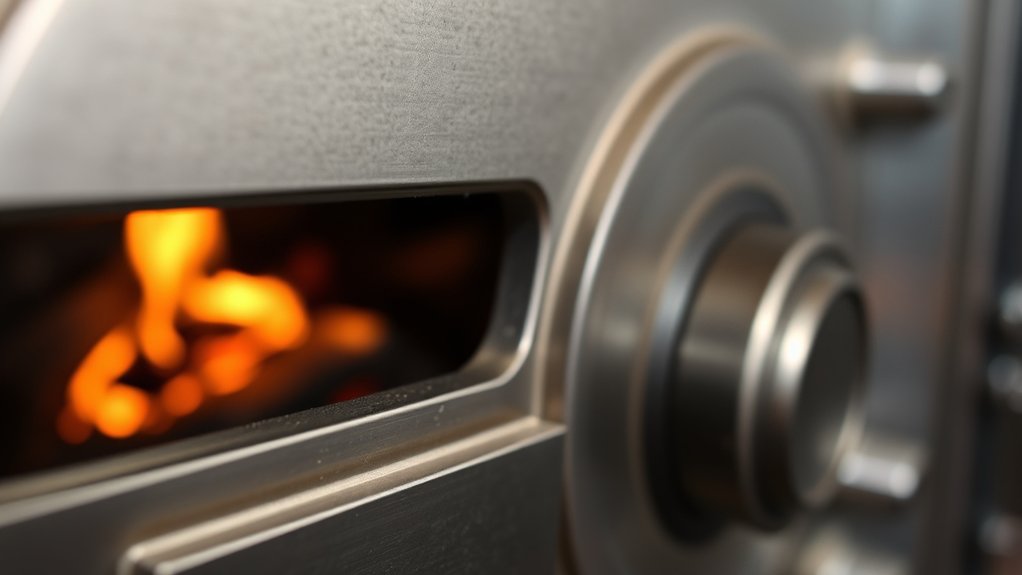
Although steel alone can conduct heat rapidly, its role as the primary structural material in gun safes is essential for maintaining the safe’s integrity during a fire. Steel provides robustness against external forces, ensuring the safe withstands structural deformation. Thicker steel gauges improve fire resistance by delaying heat penetration.
However, steel’s high thermal conductivity means it must be paired with fireproof materials to achieve maximum fire-resistant safes. Think of steel like a strong shell, but one that needs a good lining to keep the heat out.
| Feature | Impact on Fire Resistance |
|---|---|
| Steel Thickness | Increases delay of heat transfer |
| Structural Strength | Maintains safe integrity under stress |
| Thermal Conductivity | Necessitates insulating materials |
| Fireproof Material Use | Protects internal contents below 350°F |
| Door Seal Technology | Prevents smoke and heat infiltration |
Steel construction is fundamental to effective fire-resistant safes. Without it, the whole structure wouldn’t hold up as well when things get hot.
How Fireboard and Composite Insulation Keep Your Gun Safe Cool
You rely on fireboard insulation because it releases moisture when heated, which actually helps lower the internal temperature of your gun safe during a fire. It’s pretty clever how that works.
Then, you’ve got composite materials that fit snugly between steel layers. These boost thermal resistance by creating a strong barrier against heat transfer.
When you put them together, these materials work as a team to keep the inside of your safe much cooler than it would be otherwise.
That way, your firearms stay protected even in extreme heat.
Fireboard Insulation Benefits
When exposed to high temperatures, fireboard insulation releases moisture that helps keep the interior of your gun safe cooler, reducing the risk of heat damage to its contents. This moisture release creates an endothermic reaction, absorbing heat and delaying temperature rise inside the safe.
Fireboard insulation, typically ¼ to ⅝ inches thick, forms a critical barrier that slows heat transfer, enhancing fire protection for your valuable items. Safes with multiple fireboard layers extend the duration that internal temperatures remain below critical thresholds, such as 350°F, preventing damage to sensitive contents.
By integrating fireboard insulation, manufacturers greatly improve a safe’s ability to withstand high temperatures, ensuring your firearms and other valuable items remain protected during a fire event.
This precise thermal management is essential for effective fire resistance.
Composite Material Functionality
Building on the moisture-releasing properties of fireboard insulation, composite materials further enhance a gun safe’s thermal defense by providing robust barriers against heat penetration.
These materials are often lightweight and concrete-like, layered between steel sheets to maximize insulation.
When combined with fireboard, they create a synergistic effect that keeps the internal temperature below 350°F during intense fires.
You benefit from multi-layered fireboard thickness (¼ to ⅝ inches) that slows heat transfer.
Composite materials block and dissipate external heat.
Plus, fireproof safe designs integrate ceramic wool for an added thermal shield.
Together, fireboard and composite materials guarantee your gun safe maintains critical coolness.
This means your valuables stay protected effectively under extreme fire conditions.
Ceramic Wool and Advanced Insulation for Gun Safes
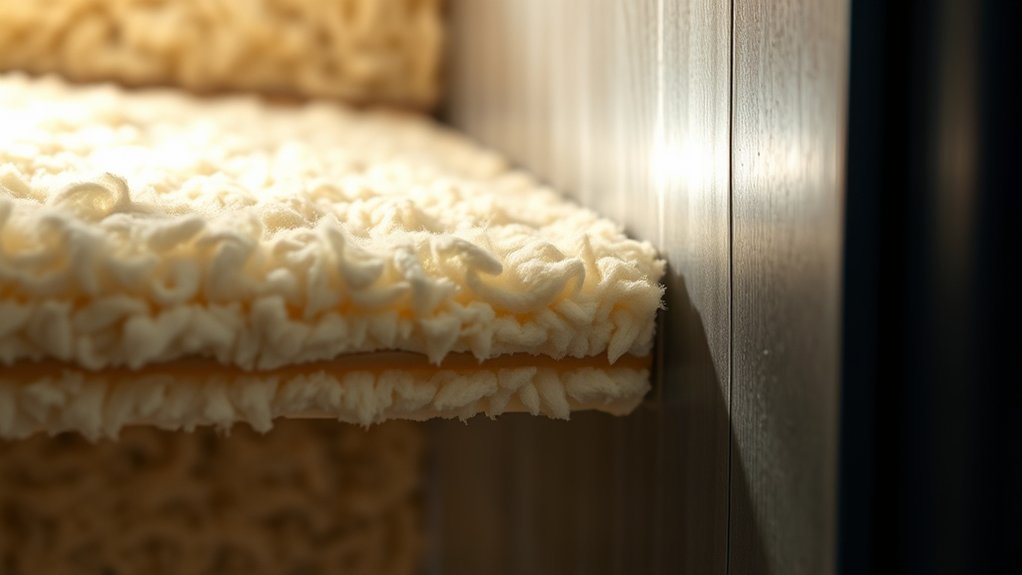
Although traditional insulation materials have served gun safes for years, ceramic wool offers a superior alternative due to its exceptional thermal resistance and lightweight structure. This advanced insulation maintains internal temperatures below critical fire resistance thresholds (around 350°F), protecting firearm integrity during prolonged heat exposure.
Unlike conventional materials, ceramic wool doesn’t emit harmful chemicals when exposed to fire, which makes it a safer choice. Its blanket-like form integrates easily into safe designs without adding excessive weight.
| Property | Ceramic Wool | Traditional Insulation |
|---|---|---|
| Thermal Resistance | High (withstands extreme heat) | Moderate |
| Weight | Lightweight | Heavier |
| Fire Resistance | Maintains <350°F | Variable |
| Chemical Emission | None | Possible harmful fumes |
| Application Ease | Flexible blanket form | Rigid panels |
Using ceramic wool advances your safe’s fire resistance considerably. It’s a smart upgrade for anyone serious about protecting their firearms.
Fire-Retardant Seals: Keeping Smoke Out of Your Gun Safe
Insulation like ceramic wool effectively controls internal temperatures during a fire, but fire-retardant seals play an essential role in blocking smoke and gases from entering your gun safe.
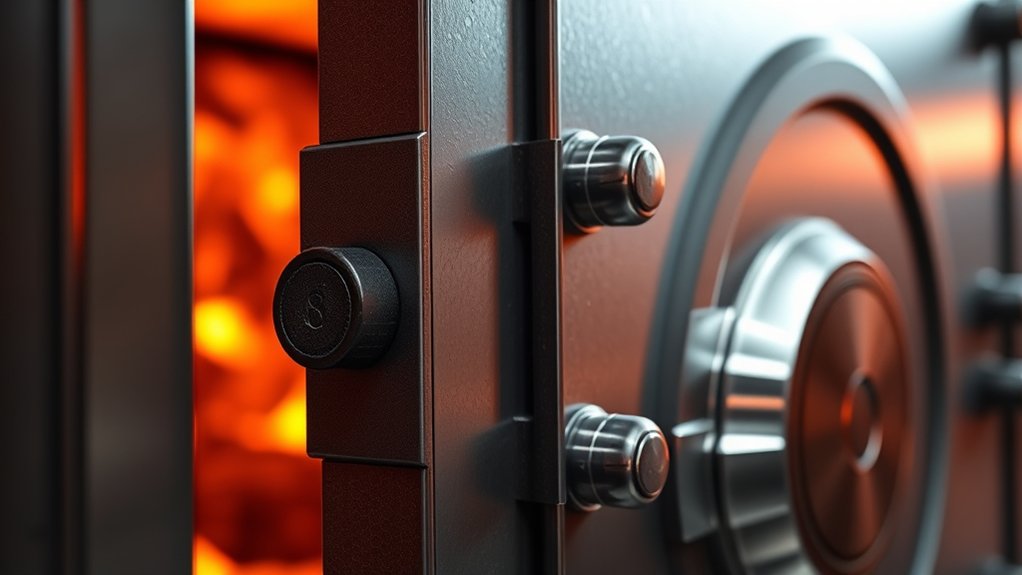
These seals, such as Palusol™, expand under high temperatures to form a dense barrier that guarantees smoke protection.
Seals like Palusol™ expand with heat, creating a dense barrier that ensures complete smoke protection.
Smoke infiltration can cause irreversible damage to firearms and documents, making these seals indispensable.
When you rely on fire-retardant seals, you benefit from effective expansion at high temperatures, sealing gaps instantly.
You also get multiple layers safeguarding vulnerable areas like door jambs and hinges.
Plus, there are maintenance protocols that help preserve the seal’s integrity over time.
Proper fire-retardant seals provide vital protection beyond heat resistance.
They keep your valuables secure from harmful smoke, which is often overlooked but just as damaging.
How Safe Design and Doors Protect Your Guns From Fire
Your gun safe’s design and door construction play a huge role in protecting your firearms from fire. They use multi-layered insulation combined with thick steel to keep the inside temperature from reaching damaging levels.
Plus, door seals like Palusol™ are pretty clever—they expand when exposed to heat, forming a barrier that stops smoke and flames from getting in.
All these features work together to boost the safe’s fire resistance, so you can feel confident that your guns will stay secure if a fire breaks out.
Door Seal Technology
When evaluating door seal technology, consider the quality of the seal material. It’s important that the material can expand well under heat. This helps keep the door tightly sealed when it matters most.
Also, think about the door’s construction—how thick it’s and what it’s made of. Materials like galvanized steel add extra protection.
Plus, make sure the door fits precisely and the locking mechanisms work well to minimize any gaps.
These gaps can let heat in, which is exactly what you don’t want. When everything works together, your safe will maintain lower internal temperatures and stay locked.
That way, both your firearms and your peace of mind are secure during a fire event.
Structural Fire Resistance
Although fire resistance depends on multiple factors, the structural design of your gun safe is paramount in protecting its contents.
Fireproof safes rely on thick firewalls, typically ¼ to ⅝ inches, to delay heat penetration effectively. The use of multiple fireboard or composite material layers, which release moisture when heated, helps keep internal temperatures below 350°F, preserving your firearms.
Thicker gauge steel also enhances structural integrity and improves resistance to both fire and unauthorized access.
Door seals like Palusol™ expand under heat, preventing smoke and heat from getting inside. Proper placement on concrete floors and away from direct flame sources further reduces fire risk.
Why Gun Safe Location and Installation Matter for Fire Protection
Since fire risks vary across home environments, selecting the proper location and installation method for your gun safe directly influences its fire resistance.
Positioning your gun safe away from high-risk areas like kitchens helps minimize fire exposure. Installing it on concrete or slab floors slows fire spread, which enhances fire protection.
Proper installation, including secure anchoring, prevents movement that could compromise safety during a fire.
So, it’s really important to think about where and how you install your safe to keep your firearms protected.
Consider these critical factors:
- Avoid placing the gun safe near combustible materials to reduce ignition risk.
- Opt for stable, fire-resistant flooring like concrete to enhance heat resistance.
- Securely anchor your safe to maintain integrity throughout fire exposure.
How to Evaluate Fire Testing and Certification for Gun Safes
When evaluating fire testing for gun safes, you want to make sure the safe has been exposed to temperatures of at least 1,200°F. This ensures the fire exposure is realistic and tough enough to protect your valuables.
It’s also important to look for certifications from independent laboratories instead of just relying on what the manufacturer claims. That way, you can be confident the tests are genuine and unbiased.
Another key thing to check is the internal temperature limits and how long the fire rating lasts. This tells you how long the safe can effectively protect its contents during a fire.
Fire Test Methods
When evaluating fire test methods for gun safes, you need to focus on how these safes are subjected to controlled furnace exposures reaching at least 1,200°F.
At the same time, internal temperatures are closely monitored to verify they stay below the critical 350°F threshold. This guarantees the safe’s contents remain fireproof during the specified duration.
Independent laboratory fire tests provide unbiased validation, unlike factory-certified tests that may lack rigor.
You should consider the consistency of testing conditions across different safe models to verify reliable fire ratings.
Also, pay attention to the duration the internal temperature remains below 350°F, because exceeding this compromises the safe’s fireproof claims.
Transparency from manufacturers about their fire test methodologies is important to confirm authenticity.
Understanding these factors helps you select a truly fire-resistant safe.
Certification Authenticity
Three key factors determine the authenticity of a gun safe’s fire certification: the rigor of fire testing protocols, the credibility of the testing laboratory, and the transparency of the manufacturer’s documentation.
To check if a certification is authentic, make sure the fire testing involves independent laboratory evaluations instead of just factory-certified claims. Those factory-only claims mightn’t be completely objective.
Also, verify that the testing exposes safes to temperatures around 1,200°F while keeping internal temperatures below 350°F for the rated duration. This ensures the safe can truly protect its contents during a fire.
Take a close look at detailed reports about the fireboard layers, door seal materials, and design features that help with fire resistance.
Manufacturers who are transparent usually provide thorough documentation and warranties covering fire damage. This kind of openness gives you more confidence in how the safe will perform.
Relying on authentic certification means you’re choosing a gun safe that has been validated by strict and verifiable fire resistance standards.
Temperature And Duration
Verifying certification authenticity sets the foundation for evaluating a gun safe’s fire resistance. However, understanding the specific temperature thresholds and duration of exposure during testing provides deeper insight into its protective capabilities.
Fire testing involves subjecting safes to intense heat of at least 1,200°F, ensuring the interior temperature stays below 350°F for the rated time. The fire rating, often 30 to 120 minutes, reflects this duration under controlled laboratory conditions.
Critical factors include the safe’s ability to maintain interior temperatures below paper’s ignition point (451°F), the thickness and number of layers of fire-board that slow heat penetration, and the reliability of independent testing over manufacturer claims.
You must analyze these elements to assess a gun safe’s true fire resistance accurately.
How Fire Resistance Affects Gun Safe Cost
Because enhanced fire resistance demands superior materials and construction, gun safes with higher fire ratings, such as 60 minutes at 1,200°F, command higher prices.
You’ll notice that the thickness and layering of fireboard directly impact cost, as additional layers provide better insulation against heat.
Incorporating advanced materials like composite or ceramic wool insulation further raises the price, given their proven effectiveness in maintaining lower internal temperatures.
Upgraded fireproof seals also increase manufacturing complexity and cost, but they greatly improve smoke and heat resistance.
When selecting a gun safe, balancing budget with fire resistance is essential.
Investing more upfront guarantees superior protection of firearms and valuables during a fire, making the added expense a smart choice for long-term security and peace of mind.
Frequently Asked Questions
Can a Gun Safe Also Protect Against Water Damage During Firefighting?
Yes, a gun safe can protect against water damage during firefighting if it features specialized seals and safe insulation designed to block water infiltration.
Firefighting techniques often involve heavy water exposure, so safes with fire-retardant sealants create barriers against both heat and moisture.
Some models undergo rigorous testing to guarantee their structure withstands water pressure. This means they combine fire resistance with waterproof features to maintain firearm integrity even under extreme conditions.
How Often Should Fire-Resistant Materials in a Gun Safe Be Replaced?
You should inspect fireproof insulation in your gun safe every few years to assess material longevity and guarantee safe performance.
Although these materials often last the safe’s lifetime, exposure to humidity or heat fluctuations can degrade them.
If your safe has endured a fire, replace the insulation immediately, even if the contents seem intact.
Regular maintenance and precise evaluations help you maintain ideal fire protection and prevent compromised material integrity.
Taking care of your safe’s insulation isn’t something to overlook.
A little attention goes a long way in keeping your valuables secure.
Do Fire-Resistant Gun Safes Require Special Maintenance Routines?
Like a watchful sentinel, your fire-resistant gun safe demands special maintenance routines to stay effective. You should regularly inspect fire ratings and seals to confirm integrity.
Checking insulation types for moisture or damage prevents compromised protection.
Maintenance tips include keeping the safe dry and avoiding extreme environments. It’s also a good idea to schedule professional inspections after exposure to heat.
These steps help preserve the safe’s fire resistance and ensure your firearms remain secure under stress.
Can Fire-Resistant Gun Safes Protect Digital Locks From Heat Damage?
Yes, fire-resistant gun safes can protect digital locks from heat damage if they meet strict fire rating standards.
You’ll want to focus on safes with advanced digital lock construction designed to endure heat exposure effects. These safes use specialized insulation to keep internal temperatures below critical thresholds, preventing lock failure.
By selecting models with verified fire ratings and quality materials, you’ll guarantee your digital lock maintains functionality even during intense fires.
It’s all about choosing the right safe that’s built to handle the heat. That way, you don’t have to worry about your lock giving out when you need it most.
Are There Eco-Friendly Fire-Resistant Materials Used in Gun Safes?
Yes, you’ll find eco-friendly fire-resistant materials in gun safes that use sustainable insulation like recycled gypsum and bio-based composites.
These materials offer strong thermal protection while supporting green manufacturing practices.
Many manufacturers pursue eco certifications to validate their environmental claims. This helps ensure reduced impact through sustainable sourcing and production.
Incorporating natural fibers, ceramic fibers, and perlite enhances fire resistance without compromising your safe’s environmental footprint.
It’s a smart way to keep your valuables protected and stay eco-conscious at the same time.
Conclusion
Now that you know the critical factors—steel strength, advanced insulation, and airtight doors—don’t underestimate their combined impact on fire resistance. But here’s the catch: even the best materials won’t protect your guns if installation or certification is overlooked.
So before you decide, ask yourself, have you truly evaluated every element that keeps your firearms safe when flames threaten? The answer could make all the difference between loss and security.